
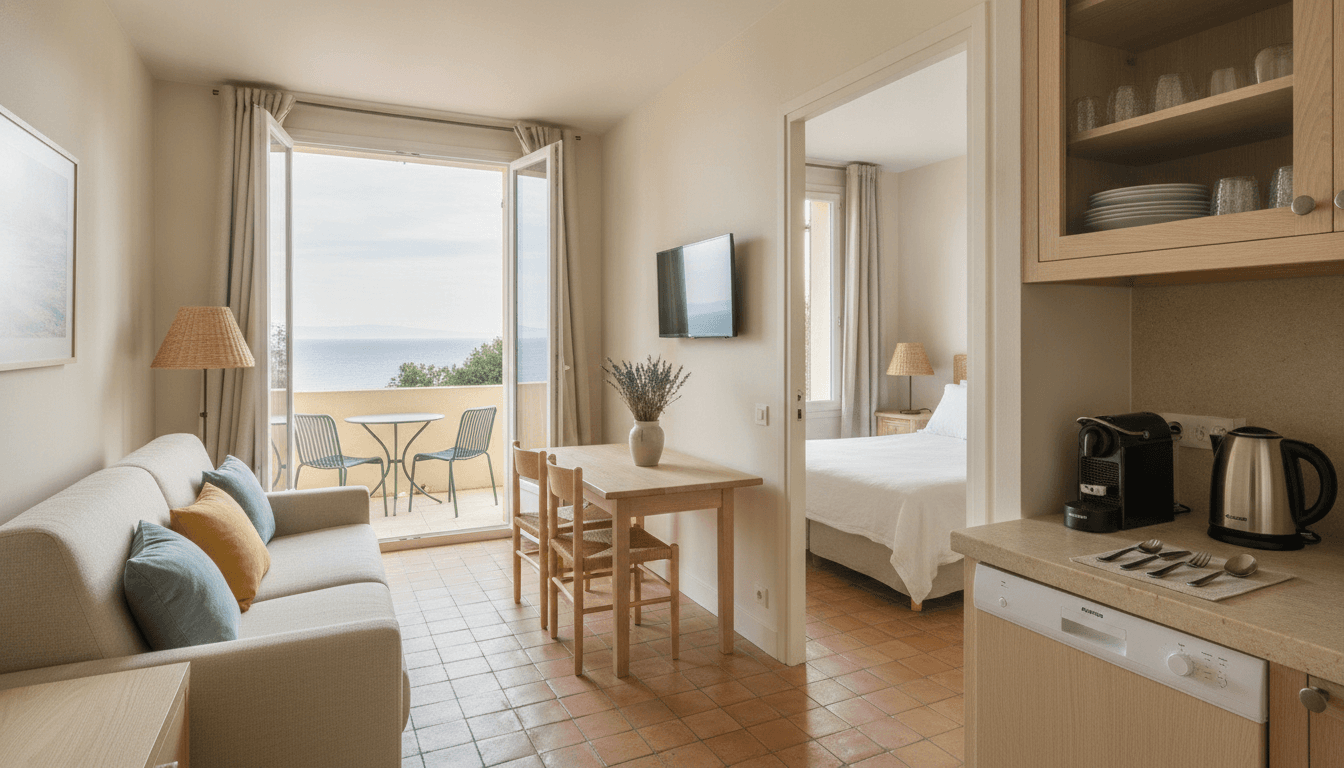
If you let a holiday apartment or second home on the French Riviera, you may be looking at tourist furnished rental classification with fresh eyes. The reason is simple: recent rules have made the gap between classified and non-classified furnished rentals more significant, and that pushes a very practical question to the front. If the inspection grid scores furniture, equipment and overall comfort, does decor now have tax value as well as visual value.
From where I stand, the answer is yes, in a very concrete sense. I am the founder of Marea Studio in Roquebrune-Cap-Martin, and I work on the parts owners can actually see and prepare: home staging, full decoration and turnkey furnishing. I do not carry out renovation, building work or architectural services. My role is to make a property read clearly, function properly and feel ready for guests.
Why tourist furnished rental classification has become a furnishing question
Many articles discuss tax and classification separately. Owners usually end up with two different checklists, one administrative and one aesthetic. In practice, they meet in the same flat.
Under the current micro-BIC framework mentioned in the recent discussions around the Le Meur law, classified furnished tourist accommodation keeps a different allowance from non-classified property. I am not a tax adviser, and owners should confirm the current rules with the right professional. Still, one point matters here: the difference is large enough that classification has become a business decision, not a nice extra.
And classification is awarded through a scoring grid. That grid looks at comfort, equipment, furniture quality, layout clarity and how complete the accommodation feels. So your sofa, bedside lights, blackout curtains, outdoor table and storage do not sit outside the tax conversation anymore. They help shape the star rating, and the star rating helps shape the tax position.
Tourist furnished rental classification criteria: what decor really changes
Owners often assume decor means colour palette and a few framed prints. The tourist furnished rental classification criteria are much more grounded than that. They reward practical completeness.
When I assess a short-let before classification, I focus on the points most likely to weaken the overall reading of the property.
- Sleeping area: proper bedside access, stable lamps, effective blackout, enough comfort for the occupancy you claim.
- Living space: circulation that makes sense, seating that matches the guest count, no awkward oversized pieces.
- Kitchen setup: equipment that feels intentional and easy to use, not a collection of leftovers from a private home.
- Bathroom styling: visual order, hooks in the right place, mirror lighting, a clean hospitality feel without overdoing it.
- Terrace or balcony: real outdoor use, not an empty space or flimsy furniture that will suffer in coastal air.
On the French Riviera, this matters even more because many properties are compact. A studio in Nice or Menton has to work harder to prove comfort than a large villa does. A poorly planned room can look busy and incomplete within seconds. A well-furnished small space can feel calm, credible and easier to book.
Star-rated furnished tourist accommodation: aim for coherence, not volume
When owners talk about a higher star level, they often think they need to add more things. I usually suggest the opposite. Add what is missing, remove what confuses the room, and upgrade what is visibly weak.
This is especially true in coastal lets. On the French Riviera, bright light exposes everything. Cheap fabrics fade quickly. Metals can suffer from salt air. Outdoor pieces need to survive heat, humidity and frequent cleaning. A terrace should read as part of the property, not an afterthought.
At Marea Studio, my furnishing choices for this kind of property are guided by use first. Can guests read in bed. Is there a comfortable place to eat indoors when the weather turns. Is there shade outside. Are there enough surfaces to put things down. Can the property be reset quickly between stays. Those questions do more for classification readiness than decorative clutter ever will.
In a short-let, good decor is often the quiet evidence that the property has been thought through.
What this means locally on the French Riviera
The region has its own pressure points. Many homes here are second residences. Many hosts depend on seasonal peaks. Outdoor areas carry real weight in guest expectations. Small footprints are common, and sea air is hard on finishes.
That changes the practical brief.
- Choose materials that cope with sun and humidity.
- Use furniture that can be moved and cleaned easily.
- Give every part of the apartment a clear role.
- Treat storage as part of hospitality, not as a bonus.
- Make the terrace usable with durable seating and a simple table.
This is also where turnkey furnishing can be useful for owners who live elsewhere. Some have a second home in Roquebrune-Cap-Martin and manage from abroad. Some are small investors preparing a first short-let. Some are estate agencies helping an owner present the property properly before launch. My job is to put together a coherent, ready-to-use interior package around the existing space, without implying building work that I do not do.
What decor can support, and what it cannot solve
It is worth keeping the limits clear. Decor cannot solve energy performance issues, registration requirements or local permissions. In Nice, owners need to keep up with registration rules, listing obligations and the changing limits that apply to short-term rentals, especially for primary residences. In some areas, change-of-use rules matter for second homes. Co-ownership rules may matter too.
The DPE calendar is another separate issue. If a property faces restrictions linked to poor energy performance, that needs specialist advice and, where relevant, improvement works by the proper trades. I do not present soft furnishing as a substitute for that.
What decor and furnishing can do is stop an administratively compliant property from underperforming at the moment it is inspected, photographed and offered to the market.
My practical order of priorities before you apply
If I were advising an owner preparing for classification on the French Riviera, I would keep the order simple.
- Confirm the legal and tax framework first with the right adviser.
- Match the interior to the occupancy and guest type you advertise.
- Improve beds, blackout, lighting and storage before buying accessories.
- Make the outdoor area usable.
- Keep finishes calm and durable.
- Take listing photos only when the property reads as complete.
If you compare providers, you may need an approved inspection body for the classification visit, a tax or legal adviser for the framework, and a furnishing and decoration studio for the preparation work. Marea Studio belongs in that last category, and I say that with an obvious bias because it is the work I do.
The honest takeaway is this: on the French Riviera, decor now sits closer to regulation than many owners realise. The classification grid gives furnishing a formal role, and the tax difference gives that role more urgency. If you want to see how I approach home staging, decoration and turnkey furnishing for this type of property, you can find it here: /en/services.