
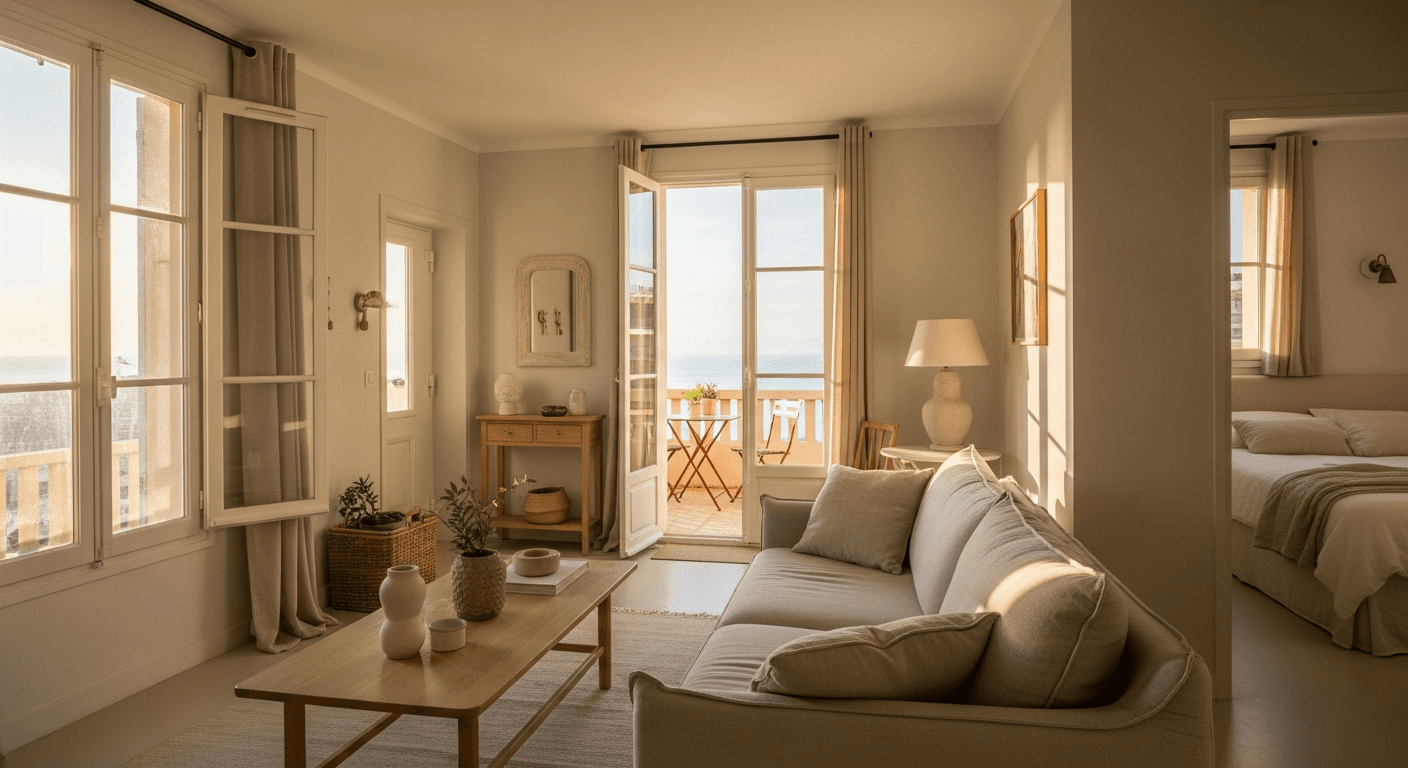
You may have a flat or house in Menton that should appeal on paper, yet the listing still feels vague. That is usually where the trouble starts. The property has assets, but they are not being read quickly enough in the photos, in the room layout, or during viewings.
This matters a lot in Menton because buyers are not one uniform audience. Some are local, some are Paris-based second-home buyers, some are small investors, and many come through an Italian-speaking route. Marea Studio sits in that exact territory. I offer home staging, full interior decoration and turnkey furnishing, with no building work, no renovation, and no architectural service. My job is to make the space easier to understand and easier to present.
On the French Riviera, Menton has a cross-border buyer profile
If you are selling on the French Riviera, Menton works differently from many other towns. The market is shaped by the border, by second homes, by seasonal use, and by Italian-speaking demand. That changes what buyers notice first.
A sea-view apartment is often judged through lifestyle clues before anything else. Can I see the light? Is the terrace usable? Does the living room feel calm enough for a second home? In the old town, the questions are different: is the plan clear, is there enough storage, does the flat feel practical year-round?
Before I suggest any styling move, I start with positioning. Who is the likely buyer, and what do they need to understand in the first few seconds?
- Second-home buyer: low-maintenance, bright, uncluttered rooms.
- Small investor: clear room function, sensible furnishing, easy upkeep.
- Short-let host: immediate usability, durable choices, good photo rhythm.
- Family buyer: circulation, dining space, storage and sleeping logic.
That sounds basic, but many listings fail because they try to address everyone at once.
Home staging on the French Riviera starts with clarity, not decoration
People often imagine home staging as adding cushions and decorative objects. In reality, the first step is usually subtraction. On the French Riviera, buyers respond quickly to light, openness and order. Heavy curtains, oversized furniture and visual noise can flatten a good property in photos.
When I work on home staging through Marea Studio, I look for the obstacles that stop a room from being read well:
- a sofa that blocks the best source of natural light
- too many small objects competing in photographs
- a dining table scaled for daily family life in a flat being sold as a pied-à-terre
- a balcony used for storage rather than outdoor living
- a spare room with no obvious purpose
The aim is not to create a fantasy interior. It is to help the buyer understand the property fast, without friction.
What buyers notice in Menton: light, salt air, terraces and compact plans
Properties in this part of the French Riviera need local common sense. Mediterranean light is generous, but it is also unforgiving. It shows dust, glare, poor paint finish and tired materials very clearly.
Humidity and salt air matter too, especially near the seafront or in homes left closed for part of the year. Lightweight curtains, washable textiles, simple wood tones and easy-care finishes often read better than fussy materials. Cheap metal pieces can age badly. Bulky storage can make a modest footprint feel tighter than it is.
Outdoor space deserves special attention. In Menton, even a small terrace or balcony carries emotional weight in a listing. It needs to look usable. Two well-proportioned chairs and breathing room will usually do more than trying to pack in a full outdoor set.
This is also where turnkey furnishing can help. It is one of the services I offer at Marea Studio, and my approach in Menton is practical: choose pieces that cope with humidity, feel visually light, and make sense for either resale presentation or short-let use.
Why Italian owners often need a more explicit visual strategy
Many owners in Menton are Italian, and many buyers pass through Italian-speaking agencies, portals, notaries or family networks. The sales ecosystem is already there. What is often missing is a visual presentation made with that audience in mind.
In practice, I would make four things explicit.
- Show the exact purpose of each area. A room that could be anything tends to feel smaller, not more flexible.
- Make storage legible. Second-home buyers care about easy use, not just charm.
- Frame the relationship to the outside. A glimpse of sea, a terrace corner, shutters, shade: these details shape desire.
- Reduce signs of maintenance burden. Clean, dry, ordered rooms reassure without any big promise.
There are active local agencies serving Italian clients, which is useful. My role at Marea Studio is different. I do not market the property as an agent, and I do not carry out renovation. I prepare the space, decoration and furnishing so the property presents itself more clearly.
What the better-known home staging figures actually tell you
Owners often ask for proof. The most widely repeated benchmark in this field comes through APHSI and Home Staging Lovers: a staged property may stay on the market for around two months, versus ten months for one that has not been prepared. I treat that as a directional reference, not a promise.
It is useful because it describes the purpose of staging well. The work is meant to remove hesitation, strengthen first impressions and make the listing easier to read. It does not mean every property behaves the same way.
A dark studio near the station, a sea-view flat full of personal furniture, and a seasonal rental needing turnkey furnishing all require different decisions. That is why I think owners should compare options honestly:
- Handle it yourself: quick and flexible, but attachment can blur choices.
- Rely only on the agency: strong on marketing and negotiation, less focused on room-by-room presentation.
- Work with Marea Studio: I bring a specific eye for staging, decoration and furnishing, with the obvious bias that this is my work.
A simple starting point if you want to sell in Menton
If your real question is how to start without overcomplicating things, keep it simple.
- Photograph every room as if the listing went live tomorrow.
- Notice what interrupts the image first.
- Clear the terrace and give it one clear use.
- Remove furniture that is too large for the plan.
- Cut personal objects that dominate the frame.
- Check for materials that look tired in humid, salty air.
- Build the version of the property that suits its likely buyer, not your habits.
If you want a clearer way to decide between home staging, full decoration or turnkey furnishing, I outline my approach on the services page.
The honest takeaway is this: in Menton, selling faster usually begins with making the property easier to read. That is especially true in a cross-border market where the first impression often happens long before the viewing.