
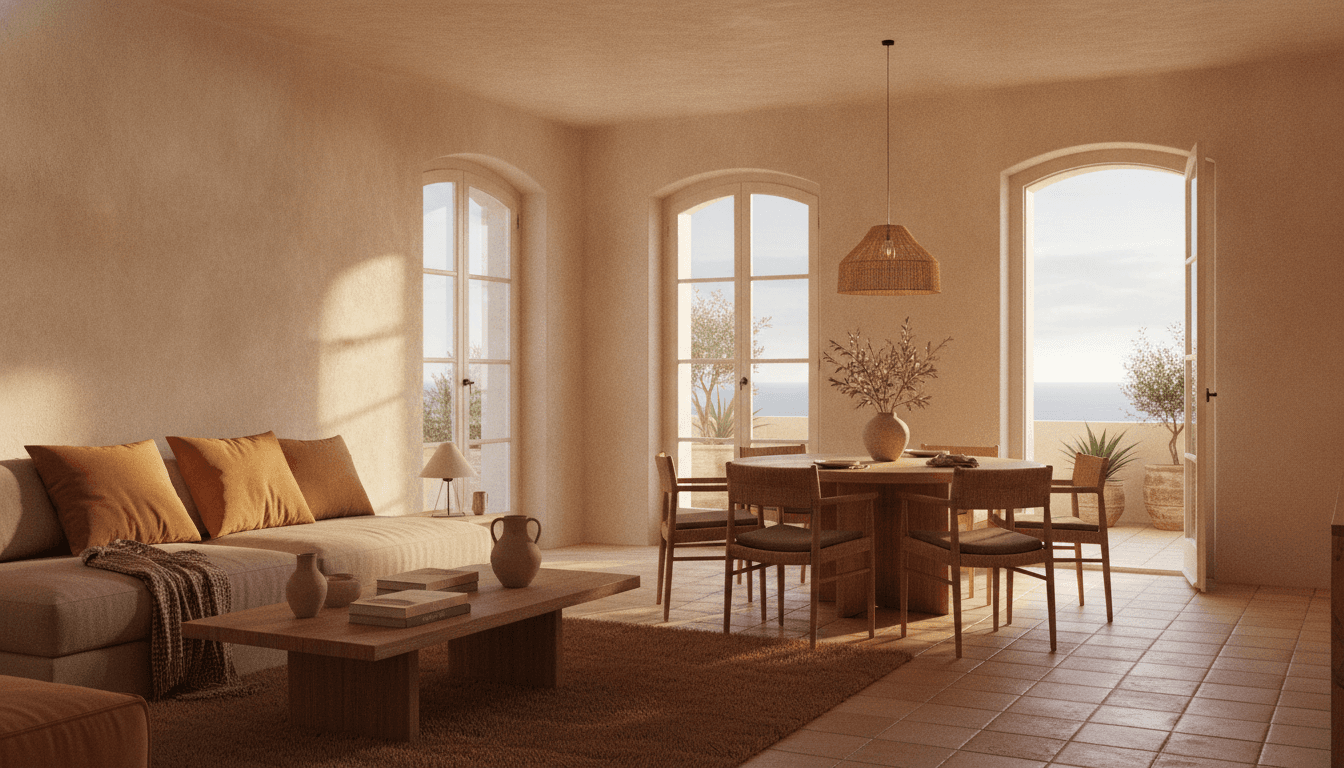
People often come to me with the same problem: they want a Mediterranean interior, but they do not want their home to look like a themed holiday rental. On the French Riviera, that concern is valid. The light is intense, terraces matter, many flats are compact, and the blue-and-white seaside formula can feel forced very fast. My way of working starts from the actual place, then builds a calmer New Mediterranean atmosphere around colour, texture, proportion and use.
What Mediterranean interior design means in 2026 on the French Riviera
The biggest mistake is to confuse Mediterranean style with nautical decoration. In Roquebrune-Cap-Martin, Menton, Nice or Monaco, the stronger reference is often not the sea itself but the land around it: faded shutters, ochre façades, dry gardens, stone, ceramic, woven fibres, filtered sun.
That is why I prefer a more grounded version of Mediterranean interior design. Less striped navy fabric, fewer literal beach references, more terracotta, olive, chalk, matte wood and handmade pieces with visual weight. The room feels tied to the Riviera without turning into a postcard.
At Marea Studio, this is part of my decoration work in a very practical sense. I edit first. I remove what feels obvious or too seasonal, then I build a palette and furniture plan that can carry the room all year.
The colour palette I use for a modern Mediterranean look
If you want a modern Mediterranean interior, start with a mineral base. Soft off-white, limestone, sand, dusty flax, pale clay. Then bring in warmer notes: terracotta, muted ochre, cinnamon, olive, dry green. These colours hold up well under strong Riviera light.
Cool whites can become harsh in a south-facing Monaco apartment. In an older Menton flat, a warmer wall tone often sits better with shutters, tiled floors or older joinery. In Roquebrune-Cap-Martin, I often look outside first. The local setting already offers a palette: pastel walls, earth tones, sun-faded colour, stone and vegetation.
My practical rule for colour balance
- Keep the largest visual surfaces quiet.
- Use one earthy note to anchor the room.
- Add green in a controlled way so the scheme does not flatten.
- Avoid sharp colour breaks in small homes.
This is also where the phrase New Mediterranean décor becomes useful. It is less about theme and more about depth.
Materials that make sense here: sun, humidity and salt air matter
A room can photograph well and still age badly. On the French Riviera, I pay close attention to fading, moisture and salt exposure, especially in homes with large openings or terraces close to the sea.
I generally favour raw or matte woods over glossy finishes. Pale oak, low-sheen walnut, textured veneers and brushed finishes tend to feel more honest in this style. For mineral elements, travertine, matte ceramic, textured plaster effects and terracotta work well because they add relief without becoming heavy.
Textiles also need some discipline. Washed linen, heavier cotton and simple woven fabrics usually age better than delicate decorative cloths. Close to a terrace, I am careful with anything that will bleach quickly or feel tired after one season. Baskets, woven shades and natural rugs are useful, but only when they are not repeated mechanically across every corner.
When I handle turnkey furnishing at Marea Studio, this is a major part of the job. I am not selecting pieces for a mood board alone. I am selecting for real use, cleaning, storage, sunlight and rhythm of occupancy.
How I adapt Mediterranean décor to small flats in Menton, Monaco and Roquebrune-Cap-Martin
Small homes do not need more decoration. They need fewer signals, placed better.
Many people try to create Mediterranean character by adding arches, fake niches, ropes, lanterns and a lot of accessories. In a compact apartment, that usually makes the space feel narrower. A better route is to create continuity and visual breathing room.
In smaller homes, I focus on these points first
- Furniture height. Lower profiles help the room feel calmer under strong light.
- Visual continuity from one area to the next. Repeating tones matters more than adding accent pieces.
- Closed storage. A cluttered room cannot carry this style well.
- Terrace connection. Even a small outdoor corner should speak the same language as the sitting area.
Monaco flats often benefit from lighter furniture footprints and stronger material contrast. Older Menton apartments can take more softness and a little patina. In Roquebrune-Cap-Martin, I often use the terrace as the extension of the living room, so the indoor palette and the outdoor pots, cushions or chairs feel related.
How to bring in New Mediterranean style without building work
This matters for two reasons. First, I do not do renovation, architecture or construction work. Second, in this area, some properties come with real constraints. In parts of Menton, especially in protected historic zones, exterior changes and some interior heritage elements may be regulated. In Monaco, if a project affects common areas or the building’s external appearance, co-ownership rules and approvals can apply.
So my approach stays within decoration, furnishing and staging.
- Rebuild the living room around a textured rug, a calmer sofa and better-scaled lighting.
- Replace shiny or overly cold finishes with matte wood and ceramic.
- Use fewer objects, but let each one have presence.
- Carry the same palette to the terrace instead of treating it as a separate scene.
- Use curtains, lamps and artwork to soften hard reflective light.
If the property is going on the market, this also overlaps with my home staging work at Marea Studio. I focus on perception: what the room says at first glance, and whether that message feels clear and locally believable.
Primary home, second home, short-let: same style, different dosage
A permanent home can hold more personality. A second home often needs calm, order and low maintenance. A short-let on the French Riviera needs an image that reads quickly, feels warm in photos and still works in real life after repeated stays.
I am open about my bias. At Marea Studio, I prefer Mediterranean interiors with restraint. On this coast, the light already does a lot of the storytelling.
If you are trying to decide between home staging, full decoration or turnkey furnishing, I explain my scope clearly on /en/services. My honest takeaway is simple: the most convincing Mediterranean rooms here usually come from subtraction first, then a few grounded choices made well.