
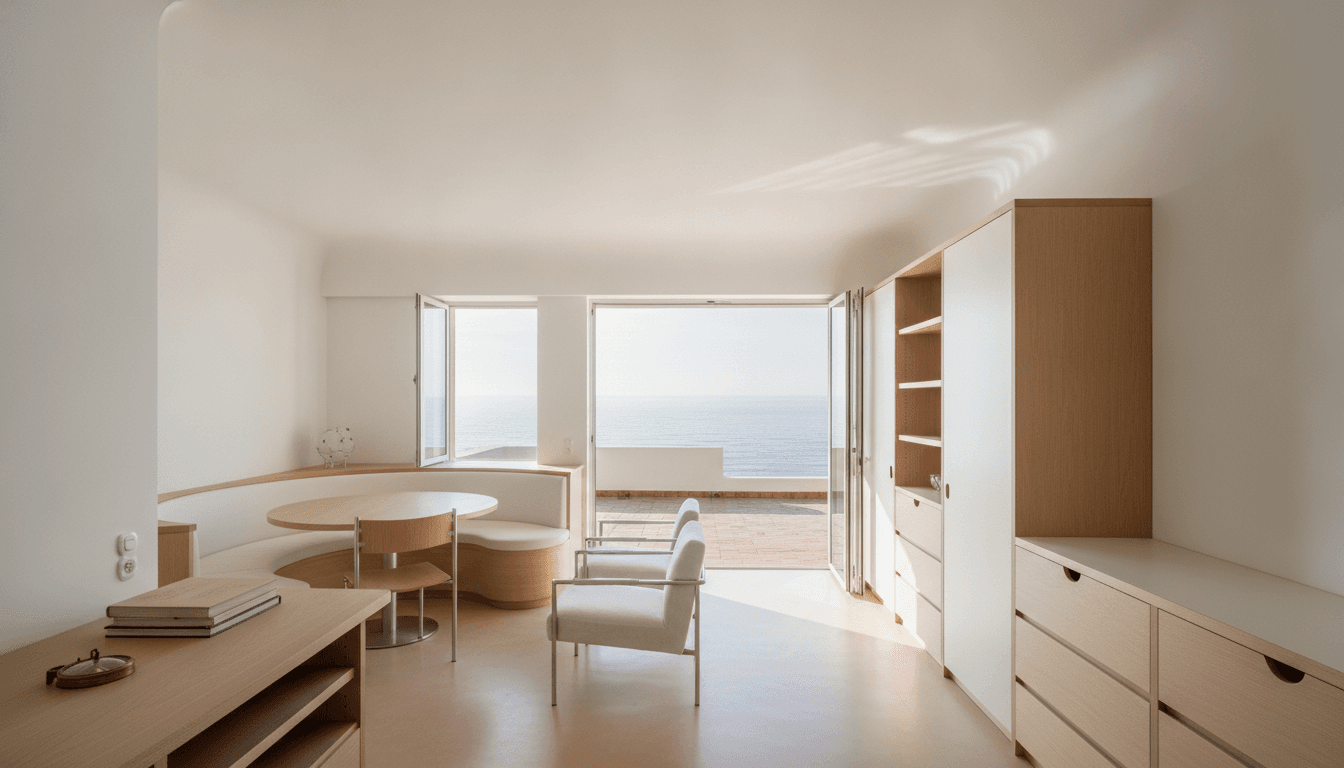
On the French Riviera, many homes try to look coastal and end up relying on obvious signs: rope, driftwood tones, stripes, blue everywhere. The result can feel dated quite quickly. E-1027, Eileen Gray’s house in Roquebrune-Cap-Martin, offers a more useful reference. It shows how a seaside interior can be functional, light-aware and visually quiet, which matters just as much in a compact flat, a second home or a short-let apartment today.
Why Eileen Gray’s E-1027 still matters in Roquebrune-Cap-Martin
E-1027 was built between 1926 and 1929 and reopened in 2021 after restoration. What makes it relevant now is not nostalgia. It is the fact that the house deals with problems I see in local properties every week: glare, small footprints, sea-facing rooms that need discipline, terraces that are underused, and interiors that need to work for holidays, guests or temporary stays without feeling improvised.
The house is modernist, but it is also practical. Built-in elements reduce clutter. Furniture has a job. Openings frame the landscape without over-dressing it. White surfaces support light rather than competing with it.
That is close to how I work at Marea Studio. I do not handle building work or renovation. My work is home staging, full interior decoration and turnkey furnishing, and in all three services I keep coming back to the same question: does the room make daily life easier, especially in a coastal setting.
The E-1027 interior: what to borrow for a Riviera flat
Start with furniture that earns its place
One of the strongest lessons in the E-1027 interior is multifunction. That matters on the French Riviera because many homes are not large, even when the location is exceptional. A bench with storage can replace loose pieces that create visual noise. A dining table can also serve as a work table if the proportions are right. A narrow console can become an arrival zone for keys, bags and chargers instead of leaving those functions to chance.
When I furnish a second home or a short-let, I try to remove anything that has only symbolic value. If a chair is there only because the corner felt empty, it usually should not stay. Rooms near the sea benefit from fewer, better-positioned pieces.
Use the local light well
Roquebrune-Cap-Martin light can be beautiful and severe at the same time. In practice, that means matte finishes usually behave better than highly polished ones. Off-whites, chalky mineral tones, pale timber, woven textures and satin metal details tend to hold up well through the day.
I am careful with bright cold whites in south-facing rooms. They can feel harsh once the sun bounces off sea, stone and glass. Softer whites and restrained contrast often produce a calmer result.
Let the view do part of the work
A sea view should not have to fight the room. In many flats, the first improvement is simply to lower the visual weight around windows and terrace doors. That can mean changing the layout, reducing side furniture, replacing heavy curtains with lighter solutions, or choosing outdoor pieces that feel connected to the indoor palette.
If a balcony is narrow, I often prefer two well-placed seats and a small table over trying to force a lounge setup that never really works. The point is to support use, not stage an image.
How these ideas help different kinds of homes here
The appeal of E-1027 is that its lessons translate well across different property types.
- For private owners: the house is a reminder that calm interiors come from editing, not filling. A few useful pieces and a clear layout often improve a second home more than decorative layering.
- For short-let hosts: good hosting starts with obvious function. Guests need somewhere to open luggage, hang beachwear, charge devices, and eat comfortably. I approach furnishing around those actions first.
- For small investors: consistency matters. Buying one item at a time often leads to mismatched scales and finishes. A furnishing plan avoids that drift.
- For estate agencies and sellers: E-1027 is a strong reference for home staging without imitation. The lesson is to strip back visual distraction and let light, proportion and outlook read clearly.
At Marea Studio, this is the exact part of the job I handle: selecting furniture, textiles, lighting and accessories in a way that suits local humidity, salt air, terrace living and seasonal occupation.
Seaside modernism versus the fake Riviera look
There is a difference between a coastal interior and a themed coastal interior. Eileen Gray’s approach helps draw that line. Instead of symbolic seaside décor, the atmosphere comes from proportion, air, utility and control.
That is useful on the French Riviera because many owners want a home that feels local without becoming predictable. White walls can work, but they need texture and balance. Natural materials can work, but they need structure. Blue can appear, but it does not need to dominate.
A simple test I often suggest is this: remove every decorative item that refers literally to the sea and look at the room again. If it suddenly feels cleaner and more expensive, the space was relying too much on theme and not enough on composition.
Cap Moderne: practical visiting notes before you go
If you want to visit the site, booking is mandatory through capmoderne.com or monuments-nationaux.fr. Cap Moderne, including E-1027, is open from April to November. For anyone furnishing or rethinking a property in Roquebrune-Cap-Martin, it is worth going with a notebook rather than treating it as a general outing.
I would pay attention to three things during the visit:
- How circulation stays clear even when furniture is present.
- How light lands on pale, matte surfaces.
- How the interior keeps a direct relationship with the landscape.
Then come home and look at your own living room, bedroom and terrace with the same criteria. Where is the room over-furnished. What blocks movement. What interrupts the view. What has no real function.
The lasting lesson of E-1027 is very plain: by the sea, a good interior does less, but does it more precisely.
One honest takeaway
In Roquebrune-Cap-Martin, E-1027 gives us a local benchmark that is more useful than trend images. It shows that seaside living works best when furniture is purposeful, light is respected and the landscape is allowed into the composition.
If that is the direction you want for a property here, I outline my approach on the services page. It is the same principle throughout: clear rooms, practical use, and furnishing that makes sense on the French Riviera.